
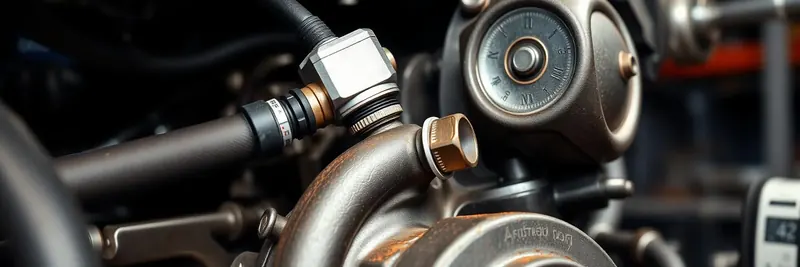
Engine management systems rely on accurate, fast-response pressure measurement at multiple points — oil galleries, intake manifold, fuel rail, crankcase ventilation, and exhaust back-pressure. Selecting the wrong sensor topology or specifying inadequate accuracy leads to enrichment errors, premature wear warnings, and emission non-compliance. Explore our pressure sensors or browse all application guides.
Sensing Technologies Used in Engine Applications
Two sensing principles dominate engine monitoring:
A silicon diaphragm with implanted piezoresistors forms a Wheatstone bridge. Under pressure-induced strain, resistance changes according to:
Governing Equation
ΔR/R = GF × ε, where GF (Gauge Factor) ≈ 100–150 for boron-doped silicon, and ε is the diaphragm surface strain. Bridge output voltage: Vout = Vex × (ΔR/R) / 2 ≈ 10–100 mV/V at full scale.
Signal conditioning (instrumentation amplifier + 12-bit ADC) converts the millivolt bridge output to a ratiometric 0.5–4.5V output referenced to supply voltage — making measurement immune to supply voltage variations, which is critical in automotive 12V/48V systems.
Manifold absolute pressure (MAP) sensors measure against a sealed vacuum reference. They provide both barometric correction and engine load data for the ECU. Typical range: 10–400 kPa absolute. Combined MAP/MAT (manifold air temperature) sensor configurations are common in modern DI engines.
The ECU uses MAP sensor output to calculate air charge mass using the ideal gas law: m = P × V / (R × T), where R is the specific gas constant for air (287 J/(kg·K)). Combined with fuel injector pulse-width, this determines the stoichiometric AFR target.
Typical Specification Requirements
| Parameter | Typical Value / Range |
|---|---|
| Measurement type | Gauge (oil/fuel), Absolute (MAP) |
| Pressure range — oil | 0–10 bar (low-friction engines), 0–15 bar (diesel) |
| Pressure range — MAP | 10–400 kPa absolute |
| Operating temperature | -40°C to +150°C (oil), -40°C to +125°C (MAP) |
| Accuracy (total error band) | ±1.5% FS over full temperature range |
| Output signal | 0.5–4.5V ratiometric; or CAN (J1939/SAE J2284) |
| Response time | <5 ms for oil pressure; <2 ms for MAP |
| Burst pressure rating | ≥4× working pressure per ISO 14830 |
| Supply voltage | 5V ±10% (ratiometric); 8–16V (CAN-output variants) |
| Qualification standard | AEC-Q100 Grade 1 (-40°C to +125°C) |
| Environmental compliance | ISO 16750-3 (mechanical), ISO 16750-2 (electrical) |
| Media wetted material | 316L stainless steel diaphragm; NBR or FKM O-ring seal |
Oil Gallery Sensor: Mounting and Media Compatibility
Engine oil pressure sensors mount in the main oil gallery or near the oil filter head. Key design considerations:
- Media: 5W-30 to 20W-50 mineral/synthetic oil — all grades compatible with 316L SS wetted parts
- Thread standard: M10×1.0 or M12×1.5 (OEM-specific); seal seat must achieve 0 bar leakage at rated torque (typically 20–35 Nm)
- Vibration exposure: ISO 16750-3 Category 1 (engine-mounted) — up to 50 gRMS from 20–2000 Hz
- Thermal shock: -40°C to +150°C cycling per ISO 16750-4 Test A
- EMC: radiated immunity per ISO 11452-2; conducted immunity per ISO 7637-2
Sensor Technology Comparison for Engine Applications
| Technology | Range | Accuracy | Output | Best Application |
|---|---|---|---|---|
| Piezoresistive MEMS | 0–150 bar | ±0.5–1.5% FS | Ratiometric/CAN | Oil pressure, fuel rail |
| Ceramic thick-film | 0–40 bar | ±1.0–2.0% FS | 4–20 mA / Voltage | Low-cost oil pressure |
| Piezoelectric | Dynamic only | ±0.1–0.5% FS | Charge output | Knock, combustion analysis |
| MEMS absolute | 10–400 kPa | ±0.5% FS | Ratiometric/Digital | MAP, EGR valve position |
Standards and Certification Checklist
- AEC-Q100 Grade 1: qualification for -40°C to +125°C environments (Grade 0 available for higher thermal exposure)
- IATF 16949: quality management system — all STPL products are manufactured under this framework
- ISO 16750 Parts 2–4: electrical loads, temperature cycling, mechanical vibration and shock
- CISPR 25 Class 5: radiated emission limits for in-vehicle electronics
- ISO 26262 ASIL: oil pressure monitoring is typically ASIL-A; low-oil-pressure shutdown interlock may be ASIL-B
Design Tip: Avoiding Pressure Spikes
Engineering Note
Reciprocating oil pumps generate pressure spikes at twice crankshaft frequency. Specify a sensor with a damping orifice (0.3–0.5 mm diameter) or an integrated snubber to limit dynamic over-pressure events. Sensors without snubbers can be damaged by spikes 3–5× above rated pressure during cold-start cranking.
Building Reliable Engine Pressure Sensor Solutions
At Sensing Technologies, we specialize in AEC-Q100 qualified pressure sensors for engine monitoring. Contact our engineering team to discuss your application requirements.
People Also Read
Automotive Sensor Applications
Comprehensive guide to automotive sensors including oil pressure and temperature.
12 min read
Read MoreOil Pressure Sensor Guide
Complete guide to oil pressure sensors — diagnosis, replacement, and maintenance.
15 min read
Read MoreBrake Pressure Sensors & ABS
How brake pressure sensors improve ABS, ESC, and braking safety.
10 min read
Read More