
Water in Fuel Sensors
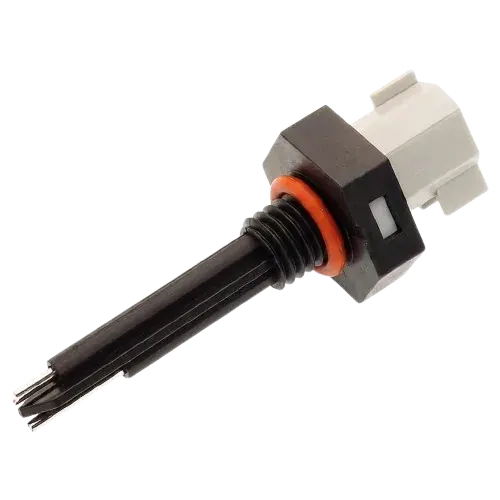
Precision water-in-fuel detection sensors for diesel fuel filter assemblies using conductivity-based measurement. Protects common rail injection systems from water damage with reliable two-stage output signaling and integrated self-test capability.
Key Applications:
- Diesel fuel filter assemblies
- Fuel-water separator systems
- Common rail diesel protection
- Commercial vehicle fuel systems
Technical Excellence:
Water in Fuel Sensor Applications
Our water-in-fuel sensors protect high-pressure diesel injection systems through early water contamination detection in fuel filter assemblies and separator housings.
Diesel Fuel Filter Assemblies
Integrated water detection for OEM fuel filter housings, triggering ECU alerts when water accumulation reaches critical thresholds to prevent injector corrosion and fuel system damage.
Fuel-Water Separator Systems
Primary and secondary separator monitoring for marine, agricultural and off-highway diesel applications requiring continuous water contamination surveillance in high-vibration environments.
Common Rail Diesel Protection
Critical water detection for Euro VI and BS-VI compliant engines, protecting precision injector components from water-induced erosion and maintaining fuel lubricity specifications.
Fleet & Commercial Vehicle Systems
Dashboard warning integration for trucks, buses and construction equipment enabling proactive filter drainage before water contamination reaches fuel injection components.
Sensor Technology & Technical Specifications
Resistive measurement sensors detecting water presence through conductivity differential between diesel fuel and water, engineered for automotive-grade reliability in contaminated fuel environments.
Advanced Water Detection Capabilities
Resistive Measurement Technology
- Conductivity-Based DetectionExploits conductivity differential between diesel (≥350kΩ) and water (≤190kΩ)
- Two-Stage Output SignalHigh/low level stages identify water presence/absence with hysteresis
Measurement Flexibility
- AC Measurement MethodAlternating polarity reduces electrode corrosion and deposit formation
- DC Measurement MethodContinuous direct voltage for simplified ECU integration
Robust Design Features
- Wide Voltage Operation5V to 36V range supports 12V and 24V vehicle systems
- Electrode ConfigurationSingle or dual electrode variants for grounded/isolated applications
Advanced Functions
- Integrated Self-TestAutomatic functionality verification at vehicle start (1-3s duration)
- Signal HysteresisPrevents signal bounce during water level transitions
- Configurable Delay Timing0.5-2s switching delay between fuel and water states
Technical Specifications
Contact us for an OEM quotation.
| Parameter | Specification |
|---|---|
| Supply Voltage Range | 5V to 36V (12V/24V systems) |
| Operating Temperature | -40°C to +125°C |
| Short-Term Operation | Up to +135°C |
| Measurement Method | Resistive (AC or DC) |
| Water Resistance Threshold | ≤190kΩ (adjustable) |
| Fuel Resistance Threshold | ≥350kΩ (adjustable) |
| Output Signal Type | Two-stage (high/low level) |
| Self-Test Duration | 1-3 seconds (configurable) |
| Switching Delay Time | 0.5-2 seconds (configurable) |
| Output Load Options | Lamp / ECU pull-up/pull-down / LED |
| Mounting Location | Fuel filter housing / separator assembly |
| Pressure Rating | Low and high pressure systems |
| Connector Options | Multiple connector and terminal types |
| Customization | Per customer request |
Frequently Asked Questions
Engineering answers to the questions our customers ask most often.
A water-in-fuel (WIF) sensor is a resistive measurement device that detects water contamination in diesel fuel through conductivity differential sensing. The sensor mounts in the fuel filter housing where water (denser than diesel) accumulates at the bottom of the separator bowl. Water exhibits significantly lower electrical resistance (typically ≤190kΩ) than diesel fuel (≥350kΩ), enabling detection through resistance measurement between electrodes. When water reaches the electrode level, circuit resistance drops below the switching threshold, triggering a two-stage output signal that alerts the ECU or dashboard warning lamp. This early contamination detection protects high-pressure common rail injectors from water-induced corrosion, erosion and lubricity degradation. Sensing Technologies manufactures resistive WIF sensors with AC/DC measurement capability, 5-36V operation, -40°C to +135°C range, integrated self-test and configurable switching thresholds. IATF 16949:2016 certified, Mumbai.
Ready to Discuss Your Water in Fuel Sensor Requirements?
Our experienced engineering team is ready to develop custom water-in-fuel sensor solutions for your specific diesel fuel system applications.