
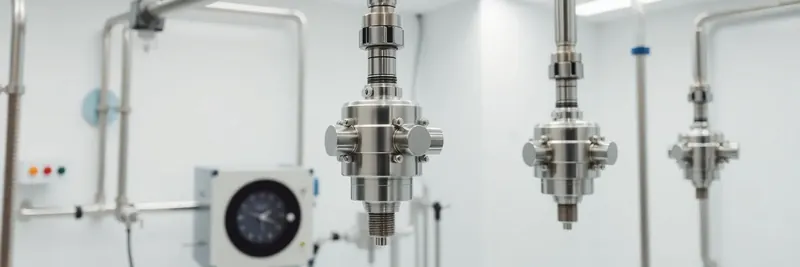
Pharmaceutical manufacturing operates under the strictest regulatory framework of any manufacturing sector. Sensors used in product-contact or critical environment monitoring roles must be designed for cleanability, validated for accuracy, and documented for regulatory compliance with FDA (21 CFR Parts 210/211), EMA, and WHO GMP guidelines. Every decision — from diaphragm material to cable entry seal — has quality and regulatory implications.
Hygienic Design: 3-A Sanitary Standards and EHEDG
Wetted-surface sensors in pharmaceutical production must comply with 3-A Sanitary Standards (USA) or EHEDG (European Hygienic Engineering & Design Group) guidelines:
- Surface roughness: Ra ≤ 0.8 μm for 3-A; Ra ≤ 0.4 μm for EHEDG (polished to 16 μin RA)
- No crevices, dead legs, or retained liquid volumes — all surfaces must drain by gravity
- Minimum 1.5° slope on horizontal surfaces; no horizontal blind tees
- Seal materials: EPDM, FKM (Viton), or PTFE-encapsulated — silicone not acceptable for most applications
- 316L stainless steel (minimum) or Hastelloy C22 for high-chloride CIP solutions
CIP and SIP Compatibility
Clean-in-Place (CIP) cycles expose sensors to:
- Caustic: 1–2% NaOH at 75–85°C for 20–30 minutes
- Acid: 0.5–1% HNO₃ or phosphoric acid at 60–70°C for 10–20 minutes
- Sanitiser: peracetic acid (PAA) 200 ppm, or sodium hypochlorite 200 ppm
Sterilise-in-Place (SIP) cycles expose sensors to saturated steam at 121–134°C (0.2–0.3 MPa gauge) for 15–30 minutes. Sensors must complete 1000 CIP/SIP cycles without performance degradation. Specify sensors with PTFE-coated diaphragms or all-PEEK wetted assemblies for SIP service.
Cleanroom Differential Pressure Monitoring
ISO 14644 classifies cleanrooms by airborne particulate count. Differential pressure between adjacent rooms prevents cross-contamination:
| ISO Class | Cleanliness Level | Typical ΔP vs Adjacent | Sensor Range Required |
|---|---|---|---|
| ISO 5 (Grade A/B) | 10,000 particles/m³ ≥0.5μm | 15–20 Pa | 0–50 Pa, ±0.5 Pa |
| ISO 6 (Grade C) | 100,000 particles/m³ | 12–15 Pa | 0–50 Pa, ±1 Pa |
| ISO 7 (Grade D) | 1,000,000 particles/m³ | 8–12 Pa | 0–50 Pa, ±1 Pa |
| ISO 8 (non-classified) | — | 5–8 Pa above corridor | 0–100 Pa, ±2 Pa |
FDA 21 CFR Part 11 and Data Integrity
Electronic sensor records (process data, alarm logs, calibration records) used to demonstrate GMP compliance must meet FDA 21 CFR Part 11 requirements:
- Audit trail: all changes to sensor parameters timestamped with operator ID
- Electronic signatures: supervisor-level authorisation for calibration changes
- Data integrity: raw sensor data must be unalterable — use write-once logging or blockchain-style audit logs
- Calibration traceability: ISO/IEC 17025-accredited calibration laboratory, traceable to national metrology standards (NIST, PTB)
📋 Validation Protocol Note
Sensor systems in regulated pharmaceutical environments require IQ (Installation Qualification), OQ (Operational Qualification), and PQ (Performance Qualification) validation protocols. Sensors must demonstrate calibration accuracy within specification before production use, and re-qualification is required after any maintenance event.