
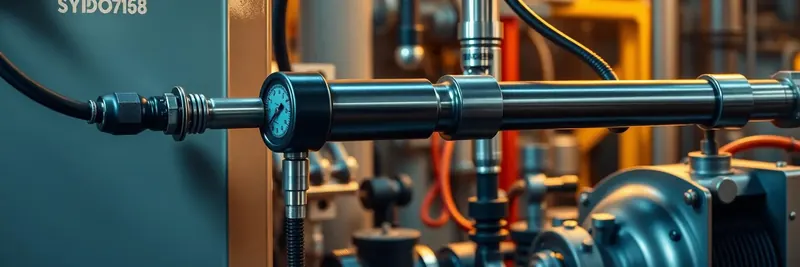
Overview
Hydraulic and pneumatic systems are mechanistically similar — both transmit force via pressurised fluid — but their pressure ranges, media properties, and safety standards differ fundamentally. A hydraulic system at 350 bar stores enormous energy density; a pneumatic system at 7 bar stores far less but is compressible, making it behave differently under leak conditions.
Hydraulic vs Pneumatic: Key Differences
| Parameter | Hydraulic | Pneumatic |
|---|---|---|
| Typical pressure range | 0–700 bar (up to 2000 bar for HHO) | 0–16 bar (most systems 0–10 bar) |
| Media | Mineral oil, water-glycol, phosphate ester HFD | Filtered dry compressed air, nitrogen |
| Burst pressure requirement | 4× rated (ISO 4413): up to 2800 bar burst | 4× rated (ISO 4414): up to 64 bar burst |
| Diaphragm material | 316L SS, Hastelloy, titanium | 316L SS, aluminium (lower cost) |
| Seal material | FKM (standard), PTFE (aggressive fluids) | NBR, EPDM, FKM |
| Safety standard | ISO 4413 | ISO 4414 |
| Risk on failure | High — fluid injection injury risk at high pressure | Medium — rapid decompression, noise |
Hydraulic Pressure Sensor Specifications
| Parameter | Typical Value / Range |
|---|---|
| Pressure range | 0–100 bar, 0–350 bar, 0–700 bar (application-dependent) |
| Burst pressure | ≥4× rated (ISO 4413 clause 4.3.2.2) |
| Sensing element | Thin-film metallic on SS (for high-pressure stability) |
| Accuracy | ±0.5% FS (general); ±0.1% FS (precision servo control) |
| Operating temperature | -40°C to +100°C (mineral oil); +125°C peak |
| Fluid compatibility | HM, HLP, HLPD oils; water-glycol HFC; phosphate ester HFD (PTFE seals) |
| Response time | <1 ms for servo-valve feedback control |
| Connector | Deutsch DT, IP67 or M12 A-coded, IP68 |
| Vibration | IEC 60068-2-64: 5–2000 Hz, 6g RMS |
Dynamic Pressure in Hydraulic Systems
Hydraulic hammer (water hammer equivalent) occurs when a solenoid valve closes rapidly, causing a pressure surge:
Pressure Surge Equation
ΔP = ρ × c × Δv, where c is the speed of sound in the fluid (~1400 m/s for mineral oil) and Δv is the sudden velocity change. For a 4 L/min flow in a 6 mm bore tube, sudden valve closure can produce a 50 bar spike in <1 ms — far exceeding the rated working pressure.
Sensors must be rated for this transient to avoid damage and ensure accurate readings during hydraulic hammer events.
Pneumatic Manifold Pressure: IO-Link Integration
Modern pneumatic systems with IO-Link pressure sensors enable:
- Remote parametrisation: set pressure thresholds and switching points from PLC without physical access
- Continuous process data: 24-bit pressure readings at up to 400 Hz update rate
- Extended diagnostics: sensor reports supply voltage deviation, temperature, and signal quality
- Predictive maintenance: trend analysis of system pressure drop across shifts to identify developing leaks
IO-Link devices connect point-to-point to an IO-Link master (port class A or B), which aggregates data to PROFINET, EtherNet/IP, or Modbus TCP via standard gateways.
Need a Hydraulic or Pneumatic Pressure Sensor?
Our team can help you select the right sensor for your hydraulic or pneumatic application — from servo-valve feedback to manifold monitoring.
People Also Read
Compressor Monitoring
Pressure sensors for compressor monitoring, protecting equipment from overpressure.
8 min read
Read MoreCompressors & Pumps Pressure Sensors
Overload protection and efficiency in industrial systems.
10 min read
Read MoreIndustrial Sensor Applications
High-precision sensors for manufacturing processes and environments.
10 min read
Read More