
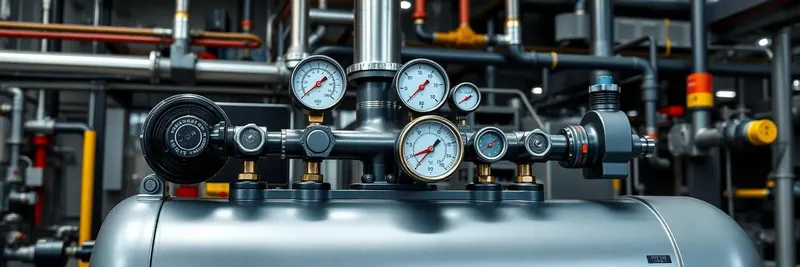
Compressors and pumps are the most energy-intensive equipment in industrial facilities, accounting for 20–40% of total plant energy consumption. Pressure sensors at suction, inter-stage, discharge, and oil-sump points are the primary inputs for efficiency optimisation, condition monitoring, and safety interlock systems.
Process Connection Standards
Before specifying a sensor, the engineer must match the process connection to the existing pipe/manifold interface:
| Thread Standard | Common Size | Region | Typical Application |
|---|---|---|---|
| G (BSP parallel) | G1/4, G1/2 | Europe, Asia | General industrial process |
| NPT (tapered) | 1/4-18 NPT | North America | High-pressure process |
| DIN 3852 Form A | M20×1.5 | Europe | Flush-diaphragm, viscous media |
| SAE O-ring Boss | 9/16-18 | Automotive | Hydraulic manifold blocks |
| Clamp / Tri-Clover | 1", 1.5" | Food/pharma | Hygienic process connections |
Pulsating Pressure Management
Reciprocating compressors (piston, diaphragm) generate pressure pulses at 2× shaft frequency. A 1500 RPM single-stage piston compressor produces 50 Hz pressure pulses that can fatigue the sensor diaphragm over time. Two mitigation approaches:
- Damping orifice: a 0.3–0.5 mm orifice restricts pulse transmission into the sensor cavity, reducing peak pressure at the sensing element while preserving average pressure accuracy.
- Pulsation dampener (snubber): a sintered stainless insert provides higher damping at the cost of slower response — acceptable for static pressure monitoring but not for surge detection.
Specification Table for Compressor Applications
| Parameter | Typical Value / Range |
|---|---|
| Pressure range | 0–16 bar (instrument air); 0–350 bar (high-pressure gas); 0–700 bar (hydraulic) |
| Accuracy | ±0.25–0.5% FS (process grade); ±0.1% FS (precision metering) |
| Output | 4–20 mA (2-wire), 0–10V (3-wire), HART 7, IO-Link V1.1 |
| Wetted material | 316L SS (standard); Hastelloy C276 (corrosive gas/liquids); PEEK (ultra-pure) |
| Operating temperature | -40°C to +85°C (transmitter); up to +150°C process (remote seal required above 85°C) |
| IP rating | IP67 (field-mount); IP69K (washdown areas) |
| ATEX/IECEx | Ex ia IIC T4 Ga (intrinsically safe Zone 0/1); Ex d IIC T4 Gb (flameproof Zone 1) |
| Long-term stability | ±0.1% FS per year typical (recalibrate every 2–5 years per ISO 9001) |
| Vibration | IEC 60068-2-64: 10–2000 Hz, 4g RMS |
ATEX Hazardous Area Considerations
Gas compressor stations handling flammable gases (natural gas, hydrogen, LPG) require ATEX/IECEx certified sensors. Selection of protection concept:
- Intrinsic safety (Ex ia): limits energy in sensor circuit below ignition threshold — preferred for sensor wiring runs through Zone 1 areas
- Flameproof enclosure (Ex d): contains any internal ignition — used where intrinsic safety barriers are not feasible
- Zone 0 applications: Ex ia only with Group IIC (hydrogen atmospheres) certification
⚡ ATEX Selection Rule
Always specify the gas group based on the most ignition-sensitive gas present. Group IIA (propane), IIB (ethylene), IIC (hydrogen/acetylene). A Group IIC sensor can be used in IIA and IIB areas, but a Group IIA sensor cannot be used in IIB or IIC zones.