
Overview
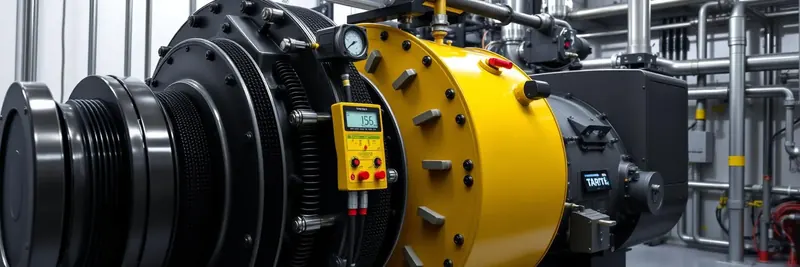
Compressor failures cost process industries millions in unplanned downtime. A centrifugal compressor surge event can destroy impeller blades within seconds; a screw compressor oil separator failure leads to process contamination. Continuous multi-point pressure monitoring is the foundation of compressor condition-based maintenance (CBM) — shifting from time-based to event-driven maintenance decisions.
Multi-Point Monitoring Architecture
| Measurement Point | Sensor Type | Typical Range | Monitoring Purpose |
|---|---|---|---|
| Suction / inlet | Gauge pressure | 0–5 bar abs | Inlet throttling loss, filter condition |
| Interstage cooler outlet | Gauge pressure | 0–20 bar | Stage compression ratio, fouling |
| Discharge | Gauge pressure | 0–350 bar (depending on type) | System pressure, delivery |
| Oil sump | Gauge pressure | 0–10 bar | Oil pump health, oil level |
| Oil separator outlet | Differential ΔP | 0–2 bar ΔP | Separator element condition |
| Interstage cooler ΔP | Differential ΔP | 0–1 bar ΔP | Fouling detection in water side |
Surge Detection: Time-Critical Pressure Measurement
Centrifugal compressor surge occurs when discharge pressure exceeds the maximum achievable for the current flow rate — the impeller stalls and reverse flow occurs. Surge detection requires:
- Pressure sensors with <10 ms response time at both suction and discharge
- High-sample-rate data acquisition (>100 Hz) to capture the surge cycle
- Anti-surge control: the controller opens a recycle valve within 50–100 ms of surge detection
- Sensors must tolerate the pressure reversal during surge (gauge pressure transiently goes negative — select sensors rated for -1 bar to +rated pressure)
Predictive Maintenance Indicators from Pressure Data
By trending pressure ratios over time, engineers can detect degradation before failure:
- Rising suction ΔP across inlet filter: filter media loading — schedule filter change
- Declining discharge/suction pressure ratio at constant speed: impeller fouling or wear — schedule cleaning
- Rising interstage cooler ΔP: scaling on water side — schedule chemical descaling
- Declining oil sump pressure: oil pump wear, oil level low, or oil separator plugging
Data Integration Tip
Connect compressor pressure sensors to the plant DCS or SCADA via HART or IO-Link with HART pass-through capability. Record raw pressure data at 1 Hz minimum; 10 Hz for surge-prone centrifugal compressors. Feed data to a process historian (OSIsoft PI, InfluxDB) for trend analysis and ML-based anomaly detection.
Sensor Specifications for Compressor Monitoring
| Parameter | Typical Value / Range |
|---|---|
| High-pressure discharge sensor | 0–350 bar, thin-film metallic, ±0.25% FS, G1/2 NPT |
| Suction sensor | 0–5 bar abs, MEMS piezoresistive, ±0.5% FS, G1/4 |
| ΔP separator element | 0–2 bar differential, ±0.5% FS, two-port G1/4 |
| Oil sump sensor | 0–10 bar, ±1.0% FS, FKM seal (mineral oil compatible), G1/4 |
| Output (all) | 4–20 mA + HART or IO-Link V1.1 |
| Operating temp | -20°C to +80°C ambient; +125°C process fluid (oil sump) |
| IP rating | IP67 minimum; IP69K for outdoor/wash-down compressor stations |
| ATEX | Ex ia IIC T4 for natural gas compressor stations |
Ready to Implement Compressor Condition Monitoring?
Our engineering team can help you design a multi-point pressure monitoring system for your compressor application.
People Also Read
Compressors & Pumps Pressure Sensors
Overload protection and efficiency in industrial compressor and pump systems.
10 min read
Read MoreHydraulic & Pneumatic Sensors
Monitoring oil, air, and gas pressures in presses, pumps, and valves.
8 min read
Read MoreHow Sensor Accuracy Impacts HVAC Energy Efficiency
How precision sensor accuracy affects HVAC energy consumption and operational costs.
9 min read
Read More