
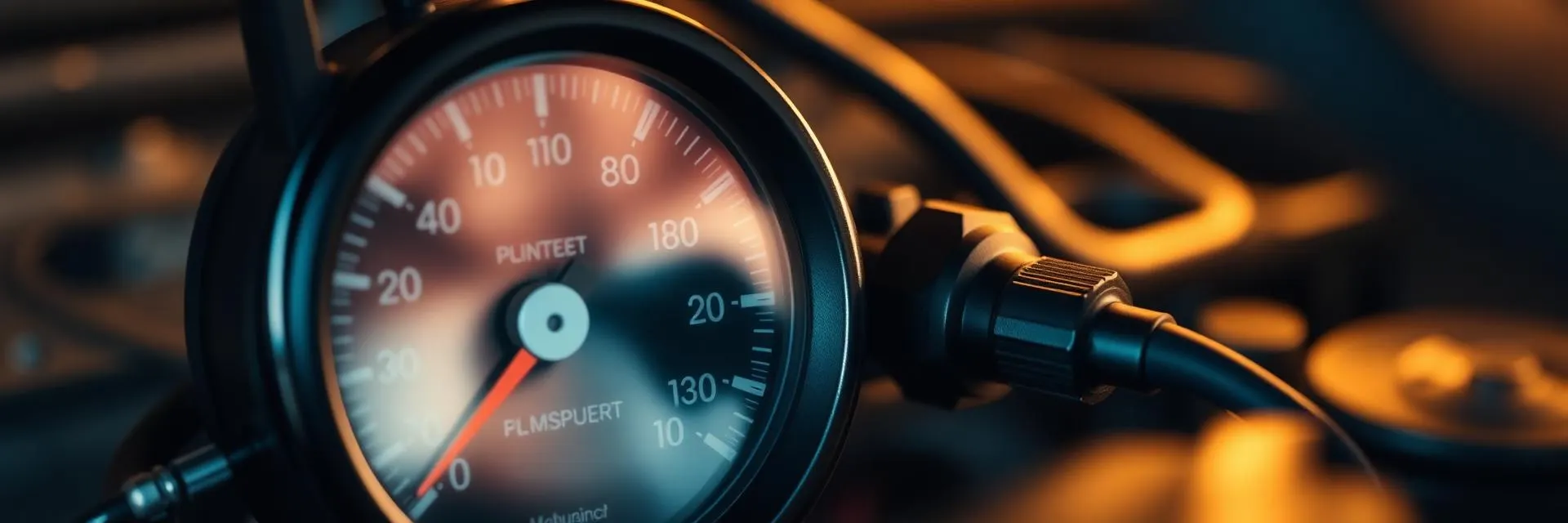
Oil pressure sensors are the primary safeguard against catastrophic engine failure. By continuously monitoring lubricant pressure throughout the oil gallery, these sensors provide the ECU with data essential for wear prevention, thermal management, and emissions compliance. Selecting the correct sensor type — switch, variable-resistance sender, or piezoresistive transducer — depends on the accuracy class, response time, media compatibility, and communication protocol required by the powertrain architecture. Explore our pressure sensors or browse all application guides.
How Does an Oil Pressure Sensor Work?
Three fundamental sensor architectures serve engine oil pressure monitoring, each suited to different accuracy and cost targets:
Binary (on/off) device using a spring-loaded diaphragm. Trips at a factory-set threshold — typically 0.3–0.5 bar — to activate a dashboard warning lamp.
- Low cost, simple wiring
- SPST or SPDT contact
- ✕No continuous data
Bourdon tube or diaphragm mechanically drives a wiper across a resistive element, producing 10–180 Ω output proportional to pressure. Feeds dashboard gauge or ECU ADC input.
- Continuous analog reading
- Legacy ECU compatible
- ✕Wiper wear limits life
MEMS silicon diaphragm with Wheatstone bridge. Outputs ratiometric 0.5–4.5 V or SENT (SAE J2716) digital signal. ≤1 ms response, ±1% FS accuracy.
- No moving parts
- EMC robust (SENT)
- OBD-II diagnostics
Governing Equation — Piezoresistive Bridge
V_out = V_supply × GF × (ΔP / P_FS) × (1 + TCR × ΔT), where GF is the gauge factor (~100 for diffused Si), P_FS is full-scale pressure, and TCR is the temperature coefficient of resistance. On-chip ASIC compensation nullifies TCR drift across −40 °C to +150 °C.
Oil Pressure Sensor Specification Matrix
| Parameter | Switch | Sender | Transducer |
|---|---|---|---|
| Range | 0.2–0.5 bar set-point | 0–7 bar | 0–10 bar (typ.) |
| Accuracy | ±15% set-point | ±5% FS | ±1% FS |
| Response Time | ~50 ms | ~100 ms | ≤1 ms |
| Output | Contact closure | 10–180 Ω | 0.5–4.5 V / SENT |
| Operating Temp | −30 to +120 °C | −30 to +120 °C | −40 to +150 °C |
| Media Compat. | Engine oil | Engine oil | Oil, ATF, coolant |
| Burst Pressure | 3× set-point | 2× FS | 4× FS |
| Endurance | 500k cycles | 1M cycles | >10⁸ cycles |
What Are the Symptoms of a Bad Oil Pressure Sensor?
The most common symptoms of a failing oil pressure sensor are a flickering oil-pressure warning lamp at idle, an erratic dashboard gauge, and OBD-II diagnostic trouble codes P0520, P0521, P0522 or P0523. Systematic diagnosis differentiates sensor faults from genuine low-pressure conditions — a critical distinction since each demands a different corrective action.
- P0520 Oil pressure sensor circuit malfunction
- P0521 Range/performance out of specification
- P0522 Low voltage — open circuit or sensor ground fault
- P0523 High voltage — shorted to supply or wiper failure
- Flickering warning lamp at idle (worn bearings or sensor drift)
- Gauge stuck at maximum (sender wiper open-circuit)
- Verify oil level and condition (viscosity, contamination)
- Read DTCs with OBD-II scanner — record freeze-frame data
- Back-probe sensor connector: measure supply voltage (5 V ± 0.25 V for transducers)
- Compare sensor output to known-good resistance/voltage curve at idle and 3 000 rpm
- Install mechanical reference gauge at gallery port — compare readings
- If sensor deviates >±5% from reference, replace sensor and clear DTCs
Critical Safety Warning
Never assume a flickering oil lamp is "just the sensor." Actual low oil pressure at bearing surfaces causes metal-to-metal contact within seconds. Always verify with a mechanical gauge before condemning the sensor. Running an engine with genuine low pressure for even 30 seconds can destroy crankshaft bearings.
How to Choose the Right Oil Pressure Sensor
| Application | Recommended Type | Key Requirement |
|---|---|---|
| Passenger car dashboard warning | Switch (SPST) | Low cost, binary alert |
| Classic car restoration | Variable-resistance sender | Gauge compatibility, 10–180 Ω |
| Modern ECU-controlled engine | Piezoresistive transducer | 0.5–4.5 V ratiometric, ±1% FS |
| Heavy-duty / commercial vehicle | Transducer + CAN/SENT | J1939 broadcast, IP69K |
| EV e-axle oil circuit | Thin-film transducer | ATF-compatible, 0–25 bar |
| Generator / stationary engine | Switch + transducer pair | Redundancy: alarm + modulation |
What Seal Material Does an Oil Pressure Sensor Need?
Oil pressure sensors are exposed to aggressive media over extended service intervals. Wetted materials must resist chemical attack, thermal degradation, and swelling from additive packages.
| Medium | Diaphragm Material | Seal Material | Temp. Limit |
|---|---|---|---|
| SAE 0W-20 / 5W-30 | 316L SS | FKM (Viton®) | 150 °C |
| ATF Dexron VI | 316L SS | HNBR | 150 °C |
| Synthetic PAO | Hastelloy C-276 | FFKM (Kalrez®) | 200 °C |
| Bio-lubricant (ester-based) | 316L SS | EPDM | 120 °C |
Engineering Note — Seal Swell Testing
Validate seal compatibility per ASTM D471 (rubber goods in liquids) using the actual OEM-specified oil with its additive package. Volume swell >15% after 1 000 h at max operating temperature indicates inadequate seal material. Include long-drain-interval oils (up to 30 000 km) in the test matrix.
How to Install an Oil Pressure Sensor
Standards & Compliance Checklist
CAN-based oil pressure PGN broadcast for heavy-duty
Digital single-edge nibble transmission for powertrain sensors
Environmental testing — vibration, thermal shock, EMC
Automotive electronics component qualification
Ingress protection against pressure wash and submersion
OEM-specific electrical and environmental requirements
Need Help Selecting an Oil Pressure Sensor?
Our engineering team can recommend the optimal sensor type, output protocol, and seal material for your engine platform. From concept through PPAP, we support the full development cycle.
People Also Read
Engine Monitoring with Pressure Sensors
Comprehensive guide to pressure sensor applications in modern engines for optimal performance and safety.
8 min read
Read MoreAutomotive Sensor Applications
Explore the full range of automotive sensors from pressure to temperature monitoring systems.
10 min read
Read MoreOil Pressure Sensors for Electric Vehicles
How oil pressure monitoring evolves in EVs for e-axle lubrication and thermal management.
7 min read
Read More