
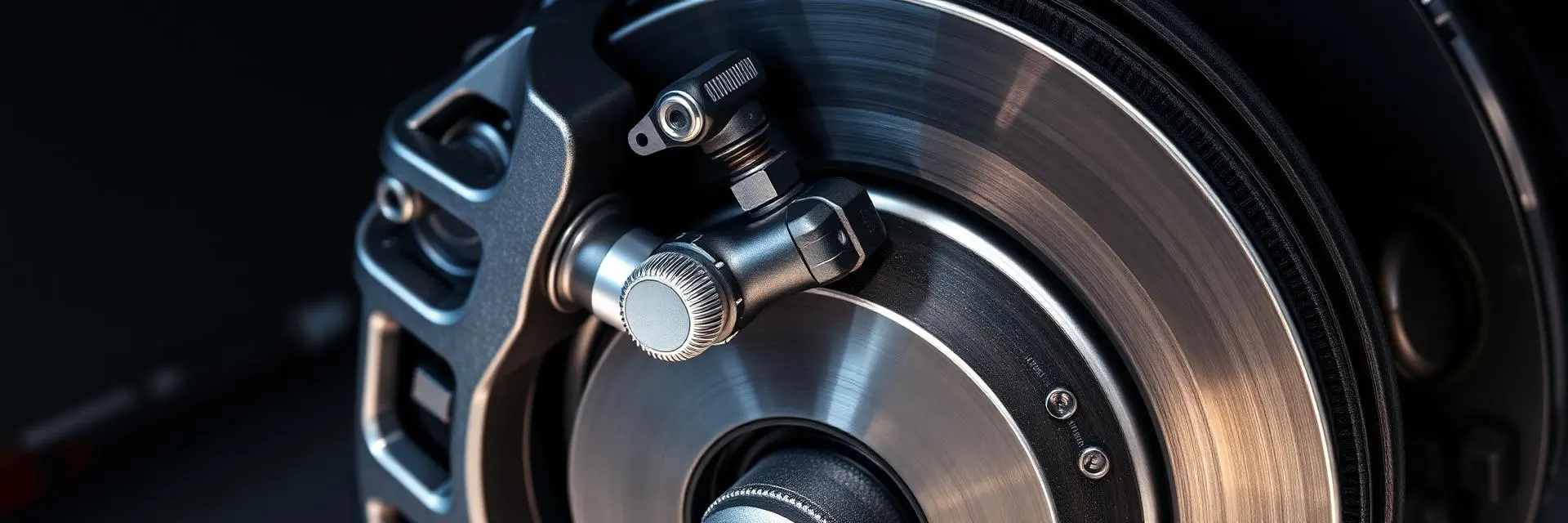
Brake pressure sensors sit at the intersection of vehicle dynamics control and functional safety. In ABS (Anti-lock Braking System), ESC (Electronic Stability Control), and EHB (Electro-Hydraulic Braking) systems, the sensor provides the hydraulic pressure feedback that allows the BCM or brake ECU to modulate apply pressure within milliseconds — preventing wheel lock, vehicle spin, or runaway brake pressure. Learn more about our pressure sensors or browse all application guides.
System Architecture and Measurement Points
In a typical four-channel ABS hydraulic modulator, pressure sensors are placed at three locations:
- Master cylinder: monitors driver demand pressure (up to 200 bar)
- Accumulator (ESC/EHB): monitors stored energy pressure (up to 300 bar)
- Individual wheel circuits (optional, high-end): measures per-wheel apply pressure
Critical Performance Parameters
| Parameter | Typical Value / Range |
|---|---|
| Pressure range | 0–300 bar (accumulator); 0–200 bar (master cylinder) |
| Burst pressure rating | ≥4× rated pressure per ISO 14830 (min 800 bar for 200 bar sensor) |
| Response time | <1 ms — required for ABS control loop at 100 Hz modulation rate |
| Total accuracy (TEB) | ±1.5% FS over -40°C to +125°C |
| Hysteresis | <0.2% FS — critical for pressure hold and release phases |
| Output signal | 0.5–4.5V ratiometric or differential SPI/SENT protocol |
| Media compatibility | DOT 3/4 glycol brake fluid, mineral oil (LHM), synthetic brake fluid |
| Operating temperature | -40°C to +135°C (fluid), -40°C to +125°C (electronics) |
| EMI immunity | ISO 11452-2, ISO 11452-4, ISO 11452-7 (antenna coupling) |
| Vibration resistance | ISO 16750-3: 20–2000 Hz, 30 gRMS (chassis-mounted HCU) |
| Functional safety | Suitable for ASIL-C with external monitoring; ASIL-D with redundant pair |
| Connector | AMP Junior Power Timer, Bosch Econoseal, or OEM-specific |
Functional Safety Under ISO 26262
Brake pressure sensing is a safety-critical function. Under ISO 26262 Part 6 (software) and Part 8 (semiconductor), the following ASIL levels typically apply:
- Wheel speed control via ABS pressure modulation: ASIL C
- ESC yaw-rate correction via individual wheel pressure: ASIL D
- EHB fail-safe pressure hold: ASIL D (requires redundant pressure paths)
ASIL Compliance Note
A single pressure sensor cannot achieve ASIL-D independently. To reach ASIL-D at system level (ASIL decomposition), two ASIL-B sensors in a 1oo2 (one-out-of-two) voting architecture are required. STPL pressure sensors are designed to meet ASIL-B hardware metrics (PMHF < 10 FIT), enabling ASIL-D decomposition.
Media Compatibility and Material Selection
Brake fluid is highly hygroscopic (DOT 3/4 absorbs moisture over time), becoming corrosive at elevated temperatures. The wetted sensor elements must be compatible with:
- DOT 3, 4, 5.1 glycol-based fluids (pH 7.5–9.5, boiling point 205–270°C dry)
- Mineral oil LHM/LHM+ (Citroën systems) — incompatible with glycol seals
- New Pentosin CHF 11S / CHF 202 for modern electrohydraulic systems
STPL brake pressure sensors use 316L stainless steel pressure ports with FKM (Viton) O-ring seals, providing compatibility with all glycol and mineral brake fluids across the -40°C to +135°C range.
Response Time and ABS Algorithm Requirements
ABS modulation cycles at 5–20 Hz (50–200 ms period), but the internal control loop sampling runs at 100–1000 Hz. The pressure sensor must settle to within 1% of final value within 1 ms of a step change. This requires:
- Sensor bandwidth: >500 Hz (-3dB frequency)
- Slew rate: capable of tracking 200 bar/ms pressure rise during brake apply
- Low hysteresis: <0.5 bar dead-band to avoid hunting in modulation phase
Sensor Comparison: ABS Brake Pressure Sensing
| Type | Range | Response | Accuracy | Safety Rating |
|---|---|---|---|---|
| Piezoresistive MEMS | 0–300 bar | <0.5 ms | ±0.5% FS | ASIL-B (single) |
| Ceramic capacitive | 0–200 bar | <2 ms | ±1.0% FS | ASIL-A |
| Thin-film metallic | 0–600 bar | <1 ms | ±0.3% FS | ASIL-B |
| Piezoelectric | Dynamic only | <0.1 ms | N/A static | Not applicable |
Building Reliable Brake Safety Solutions
Modern braking systems demand intelligent sensing with ASIL-rated reliability. Contact our engineering team to discuss brake pressure sensor integration.
People Also Read
Engine Monitoring Pressure Sensors
Pressure sensors for oil, fuel, and coolant systems ensuring engine reliability.
8 min read
Read MoreAutomotive Sensor Applications
Comprehensive guide to automotive sensor applications for engine management.
12 min read
Read MoreTransmission & Powertrain Sensors
Position and temperature sensors for accurate shifting and durability.
10 min read
Read More