
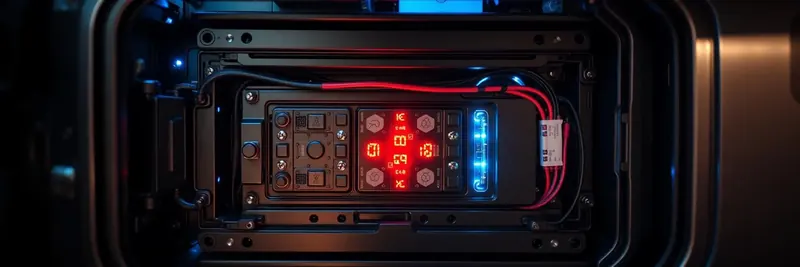
Li-ion battery packs operate optimally between 15°C and 40°C. Outside this range, capacity loss, dendrite formation (below 0°C), and thermal runaway risk (above 60°C) threaten both vehicle range and safety. Pressure and temperature sensors embedded in the Battery Thermal Management System (BTMS) provide the real-time data that battery management systems (BMS) need to maintain cells within this window — especially under fast-charge (2C+) and peak-discharge conditions. Browse all application guides.
1. Coolant Circuit Pressure Monitoring
Liquid-cooled battery packs require pressure monitoring at pump outlet and pack inlet/outlet to detect pump failure, blockage, and internal leakage.
| Parameter | Typical Value / Range |
|---|---|
| Coolant circuit pressure range | 0–6 bar (typical); up to 10 bar for high-performance packs |
| Accuracy | ±0.5% FS |
| Temperature range | -40°C to +85°C (sensor body); fluid up to +65°C |
| Output | 0.5–4.5V ratiometric or CAN-FD frame |
| Media compatibility | 50% ethylene glycol / deionised water (conductivity <10 μS/cm) |
| IP rating | IP67 minimum; IP69K for high-pressure wash-down zones |
| Connector | Molex MX150, TE Connectivity AMP, or OEM-specific |
2. Cell Swelling Detection
Pouch and prismatic LiFePO4/NMC cells expand during charge and contract during discharge. A force or pressure sensor on the cell stack measures mechanical pressure evolution. Expansion beyond ~5% capacity loss over baseline triggers a BMS alert for cell replacement.
3. Coolant Temperature (Inlet/Outlet)
Two NTC thermistors (10kΩ at 25°C, B-value 3435K) measure coolant temperature at battery pack inlet and outlet. The temperature rise ΔT = Q / (ṁ × Cp), where Q is heat dissipated by cells, ṁ is coolant mass flow rate, and Cp = 3.7 kJ/(kg·K) for 50% glycol mixture.
Thermal Runaway Early Detection
In thermal runaway, internal short circuits generate rapid heat and gas (CO₂, H₂) before external temperature rises significantly. Pressure sensors inside the pack can detect vent gas pressure rise 2–5 seconds before temperature sensors saturate.
Safety Design Requirement
Per UN ECE R100 Rev. 3 (2022) and GB 38031, EV battery packs must provide at least 5 minutes of warning before passenger exposure to hazardous thermal runaway.
Regulatory and Certification Framework
- UN ECE R100 Rev. 3: REESS safety requirements
- ISO 6469-1: EV safety — protection against electrical hazards
- IEC 62660: Li-ion cell performance and reliability testing
- ISO 26262: functional safety — BMS includes pressure sensor fault detection (ASIL-B typical)
- AEC-Q100 Grade 1: semiconductor devices in the sensor ASIC
EV Battery Sensing Solutions
Contact our engineering team for AEC-Q100 qualified battery pack pressure and temperature sensors.