
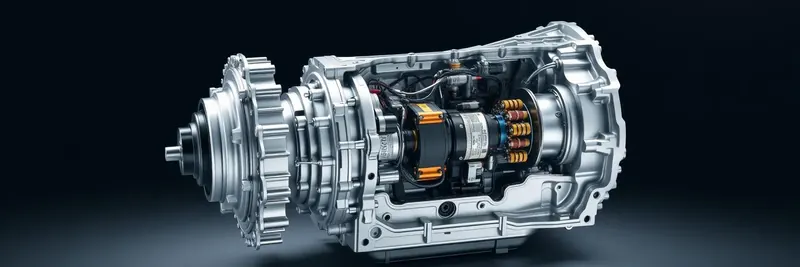
Modern automatic transmissions (AT, DCT, CVT) use hydraulic pressure at 5–15 distinct measurement points to control shift quality, clutch engagement, torque converter lock-up, and lubrication. Pressure sensor accuracy and response time directly determine shift quality — a 5% error in clutch apply pressure causes noticeable jerk during gear changes. Browse all application guides.
Transmission Pressure Measurement Points
| Circuit | Pressure Range | Function | Accuracy Required |
|---|---|---|---|
| Main line (hydraulic pump) | 5–40 bar | Overall system pressure reference | ±1.5% FS |
| Clutch apply (gear selection) | 0–25 bar | Gear engagement force control | ±1.0% FS |
| Torque converter | 0–15 bar | Converter lock-up control | ±1.5% FS |
| Lubrication / cooling | 0–8 bar | Bearing and gear lubrication | ±2.0% FS |
| Line pressure (CVT) | 0–70 bar | Belt/chain clamping force | ±0.5% FS |
Signal Interface: SENT Protocol
Modern TCUs increasingly use SENT (SAE J2716) instead of ratiometric voltage output:
- Digital transmission: immune to supply voltage variation and resistive wiring losses
- 4-bit nibble encoding at 27 μs tick time; 12-bit pressure resolution
- Fast channel (current measurement) + slow channel (status, diagnostics, sensor ID)
- Self-diagnostics: sensor reports supply voltage, temperature, and fault codes
SENT vs Ratiometric: When to Use Each
Use SENT for new platform designs with TCU hardware support — better EMC, higher resolution, built-in diagnostics. Use ratiometric 0.5–4.5V for existing platforms with analog ADC inputs.
ATF Media Compatibility
| ATF Specification | Compatibility |
|---|---|
| ATF Dexron VI | Compatible — 316L SS, FKM seals |
| ZF TE-ML-09 | Compatible — verified at 150°C, 50,000 hours |
| Aisin Warner JWS 3309 | Compatible — low-viscosity, high additive package |
| JATCO NS-3 | Compatible — specific to Nissan CVT belt systems |
| Toyota WS | Compatible — 316L SS recommended over brass |
| Pentosin ATF-1 | Compatible with standard FKM seals |
Response Time and Shift Control
A DCT shifts by simultaneously releasing one clutch and applying another — pressure crossover must complete in 150–300 ms. Pressure sensors on both clutch circuits must respond within 5 ms.
For CVT pulley pressure (0–70 bar), a 1% error in clamping pressure causes ~2% belt slip. CVT sensors use thin-film metallic elements with ±0.3% FS accuracy.
Transmission Pressure Sensor Solutions
Contact our engineering team for ATF-compatible pressure sensors with SENT or ratiometric output.