
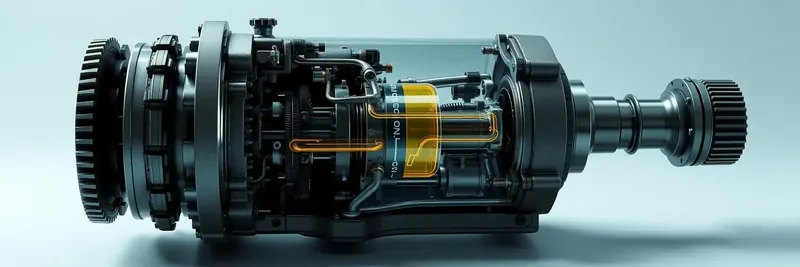
A common misconception is that electric vehicles eliminate the need for oil pressure sensors. In reality, EV e-axles (integrated motor, reduction gear, and power electronics in a single housing) require lubrication of helical reduction gears, differential bearings, and motor rotor bearings. Oil pressure monitoring is as critical to e-axle reliability as it is to an ICE engine — and the stakes are higher, because e-axle repairs are far more expensive.
Why e-Axles Need Oil Pressure Monitoring
A typical 2-speed or single-speed EV e-axle uses an oil-splash or pressure-fed lubrication system for:
- Helical reduction gears (typically 7:1–12:1 reduction ratio) — need film lubrication to prevent micropitting
- Tapered or angular-contact bearings at motor shaft and differential — need minimum 0.5 bar oil pressure to maintain hydrodynamic film
- Oil-cooled stator windings (some architectures) — circulate oil over winding end-turns for peak-power thermal management
- Power module cooling (in integrated e-drive units) — shared oil loop with motor cooling
Measurement Architecture
| Parameter | Typical Value / Range |
|---|---|
| Measurement point | E-axle oil sump outlet / pump discharge |
| Pressure range | 0–8 bar (typical e-axle oil circuit) |
| Media | Synthetic PAO or ester-based e-axle fluid (low conductivity: <100 μS/m) |
| Operating temperature | -40°C to +150°C (sump area near motor) |
| Output | 0.5–4.5V ratiometric or CAN 2.0B |
| Accuracy | ±1.5% FS over full temperature range |
| Response time | <20 ms (adequate for pump fault detection) |
| AEC-Q100 Grade | Grade 1 (-40°C to +125°C); Grade 0 if adjacent to motor |
EV Reducer Oil Specification Compatibility
EV e-axle oils are fundamentally different from conventional gear oils:
- Very low electrical conductivity (<100 μS/m) to prevent current tracking through the oil film between rotor and stator
- Low copper corrosivity (ASTM D130 rating 1A) — copper windings are sensitive to corrosive oil additives
- Compatibility with phosphor-bronze bushings, aluminium housings, and magnet coatings (NdFeB magnets react with acid-forming degradation products)
Sensor wetted materials must be validated against the specific e-axle oil chemistry. 316L SS and FKM seals are typically compatible, but PTFE-coated diaphragms offer superior long-term resistance to additive attack.
Impact on Range and Efficiency
⚡ Efficiency Impact
Insufficient lubrication causes gear micropitting and bearing wear, which increases mechanical friction. A 0.2% increase in drivetrain mechanical efficiency corresponds to approximately 1.5 km additional range in a 400 km EV. Oil pressure monitoring enables condition-based maintenance strategies that preserve drivetrain efficiency over the vehicle's 200,000 km service life.