
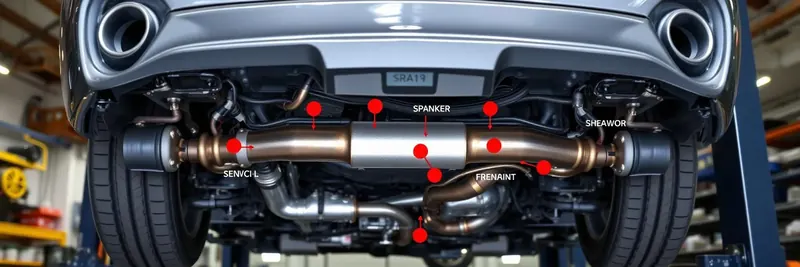
A modern passenger vehicle uses 50–100 pressure and temperature sensors across all major subsystems. This hub page maps each application to the correct sensor type, key specifications, and qualification standard — serving as a starting point for engineers specifying sensors across automotive programs.
Application-Sensor Matrix
| Subsystem | Sensor Type | Range | Output | Standard |
|---|---|---|---|---|
| Engine — oil pressure | Piezoresistive MEMS | 0–15 bar | 0.5–4.5V / CAN | AEC-Q100 Gr.1 |
| Engine — MAP | Absolute MEMS | 10–400 kPa abs | 0.5–4.5V / SPI | AEC-Q100 Gr.1 |
| Engine — coolant temp | NTC 10kΩ | -40 to +130°C | Resistance | AEC-Q200 |
| Fuel — rail pressure | Piezoresistive | 0–200 bar (GDI) | 0.5–4.5V | AEC-Q100 Gr.0 |
| Transmission | Piezoresistive / Thin-film | 0–40 bar | SENT / Ratiometric | AEC-Q100 Gr.1 |
| Brakes — ABS/ESC | Piezoresistive MEMS | 0–300 bar | 0.5–4.5V / SPI | AEC-Q100 + ASIL-B |
| HVAC — evaporator | NTC thermistor | -10 to +50°C | Resistance | AEC-Q200 |
| HVAC — refrigerant | Piezoresistive | 0–35 bar (R1234yf) | 0.5–4.5V | AEC-Q100 Gr.1 |
| EV — battery coolant | Piezoresistive | 0–10 bar | CAN / Ratiometric | AEC-Q100 Gr.1 |
| EV — e-axle oil | Piezoresistive | 0–8 bar | Ratiometric | AEC-Q100 Gr.1 |
| Tyre — TPMS | Absolute MEMS | 0–5 bar | RF 315/433 MHz | AEC-Q100 Gr.1 |
| Exhaust — DPF ΔP | Differential | 0–100 kPa | Ratiometric | AEC-Q100 Gr.0 |
Quality and Process Framework: IATF 16949
All sensors supplied to Tier-1 and OEM customers must be manufactured under IATF 16949 quality management, which mandates:
- APQP (Advanced Product Quality Planning): risk assessment and control plan before production launch
- PPAP (Production Part Approval Process): full dimensional and functional validation at all significant change points
- FMEA (Failure Mode and Effects Analysis): design FMEA (DFMEA) for sensor design; process FMEA (PFMEA) for manufacturing
- Control plan: documented inspection points, frequencies, and reaction plans for out-of-specification results
- SPC (Statistical Process Control): Cpk ≥ 1.67 for all critical characteristics per customer-specific requirements
AEC-Q Component Qualification Grades
| Grade | Temperature Range | Application Examples |
|---|---|---|
| Grade 0 | -40°C to +150°C | Engine combustion zone sensors, fuel rail sensors |
| Grade 1 | -40°C to +125°C | Most automotive body/chassis sensors |
| Grade 2 | -40°C to +105°C | Passenger compartment sensors |
| Grade 3 | 0°C to +85°C | Not automotive — commercial only |