
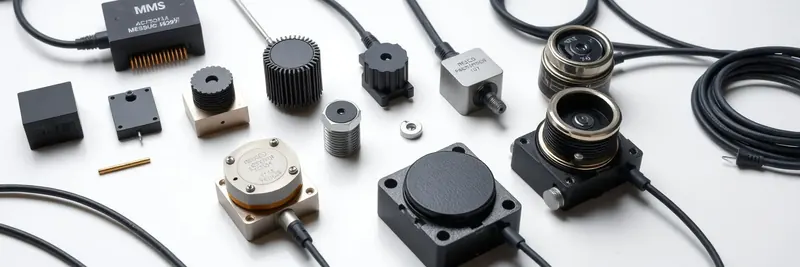
What is Ceramic Pressure Sensor Technology?
Ceramic pressure sensor technology uses a 96–99.6% pure alumina (Al2O3) diaphragm as the pressure-sensing element. Thick-film piezoresistive elements are screen-printed and fired onto the back face of the ceramic in a Wheatstone bridge configuration. Pressure deflects the diaphragm by a few microns; the bridge converts the strain into a millivolt signal that an on-chip ASIC amplifies and temperature-compensates to a 0.5–4.5 V ratiometric or SAE J2716 SENT output.
Why Use Ceramic Instead of Metal or Silicon?
Metal (316L SS) diaphragms corrode in EGR exhaust, sulphurous fuels and ageing engine oils; silicon MEMS diaphragms cannot tolerate direct contact with conductive or particulate media. Alumina ceramic is chemically inert across the full automotive media set, withstands continuous 200 °C exposure without creep, and is dimensionally stable (very low CTE, ~7 × 10⁻⁶/K) so accuracy remains within ±3% FS for the entire vehicle service life.
Ceramic vs Stainless Steel vs Silicon Diaphragm
| Property | Ceramic (Al2O3) | 316L SS | Silicon MEMS |
|---|---|---|---|
| Max media temp | +200 °C | +150 °C | +125 °C |
| Corrosion resistance | Excellent (inert) | Good | Requires barrier oil |
| Long-term drift | <0.1% FS / year | ~0.3% FS / year | ~0.2% FS / year |
| Burst pressure | 5× FS | 3× FS | 2× FS (with iso-diaphragm) |
| Cycle life | >10⁸ | 10⁶–10⁷ | 10⁷–10⁸ |
| Best applications | EGR, oil, fuel, HVAC, brake | Hydraulic, refrigerant | MAP, low-pressure |
Where Are Ceramic Pressure Sensors Used?
- EGR pressure sensing — soot, sulphur and 200 °C exhaust gas
- Engine oil pressure — additive-rich oils with long drain intervals
- Fuel rail / common-rail diesel — sulphur and bio-fuel compatibility
- Brake (ABS / ESC) — DOT-4/DOT-5.1 brake fluid, hygroscopic
- HVAC refrigerant — R134a, R1234yf and R744 (CO2) up to 130 bar
- EV battery coolant — glycol blends, dielectric coolants
How is a Ceramic Pressure Sensor Manufactured?
Alumina powder is pressed and sintered at ~1600 °C into a disc with an integral cavity. The piezoresistive Wheatstone bridge is screen-printed in proprietary thick-film paste on the back face and co-fired. The disc is laser-trimmed for offset and span, brazed or glass-sealed into a stainless-steel pressure port, and bonded to a signal-conditioning ASIC. Final calibration spans the full operating temperature range (−40 °C to +150 °C) on automated end-of-line testers — a process Sensing Technologies operates under IATF 16949:2016 controls in Mumbai.
Ceramic Pressure Sensor Manufacturer in India
Sensing Technologies has manufactured ceramic-diaphragm pressure sensors for Tier-1 automotive OEMs from our IATF 16949:2016 Mumbai facility since 1985. Our portfolio covers 0–600 bar with custom port threads, connectors and output protocols, and is validated to ISO 16750, AEC-Q100 and OEM-specific environmental specs. View our pressure sensor portfolio →