
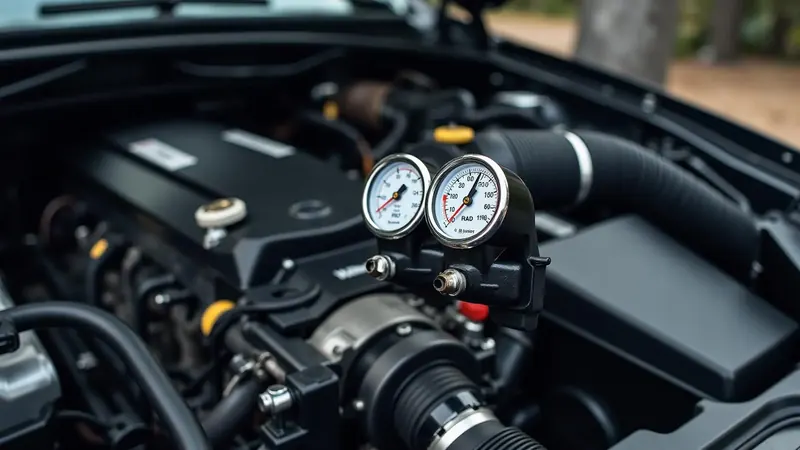
What is a MAP Sensor?
A MAP (Manifold Absolute Pressure) sensor is an automotive sensor that measures the absolute pressure inside the engine's intake manifold. The ECU uses MAP together with engine RPM and intake-air temperature in a speed-density algorithm to calculate the air mass entering each cylinder, then meters fuel and ignition timing accordingly. Modern MAP sensors are silicon piezoresistive devices with 0.5–4.5 V ratiometric output and ±1.5% full-scale accuracy.
MAP Sensor vs MAF Sensor: What is the Difference?
A MAP sensor measures absolute pressure inside the intake manifold; the ECU infers air mass from pressure, RPM and temperature (the speed-density method). A MAF (Mass Air Flow) sensor uses a heated film or hot-wire element to measure air mass directly as it enters the engine. MAP is cheaper, faster-responding and tolerates intake leaks better; MAF is more accurate at part-load and is common on large-displacement and turbocharged platforms. Many modern engines run both for redundancy and OBD rationality checks.
How Does a MAP Sensor Work?
A MAP sensor uses a silicon micro-machined diaphragm with a vacuum reference cavity. Manifold pressure deflects the diaphragm against the vacuum reference; piezoresistive elements arranged in a Wheatstone bridge convert the deflection into a millivolt signal. An on-chip ASIC amplifies and temperature-compensates the output to a ratiometric 0.5–4.5 V analog signal, or to SAE J2716 (SENT) digital output for modern ECUs.
What Are the Symptoms of a Bad MAP Sensor?
- P0105 MAP circuit malfunction
- P0106 Range / performance problem
- P0107 / P0108 Low or high voltage input
- Rough idle, surging, hesitation on tip-in
- Poor fuel economy and black smoke (rich mixture)
- Failed emissions test (high HC and CO)
MAP Sensor Specifications
| Parameter | NA Engine | Turbo / Boosted |
|---|---|---|
| Range | 10–105 kPa abs | 20–300 kPa abs |
| Accuracy | ±1.5% FS | ±2% FS |
| Output | 0.5–4.5 V ratiometric | 0.5–4.5 V or SENT |
| Operating temp | −40 to +125 °C | −40 to +135 °C |
| Integrated IAT | Optional | Standard |
MAP Sensor Manufacturer in India
Sensing Technologies designs and manufactures MAP sensors for passenger cars, two- and three-wheelers, commercial vehicles and off-highway engines under IATF 16949:2016 in Mumbai. We support naturally aspirated and turbocharged variants up to 300 kPa with optional integrated IAT and connector / thread customisation. Request samples or PPAP documentation →