
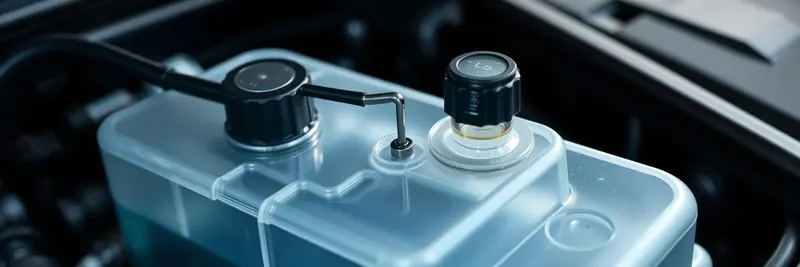
Capacitive Sensing Principle
The sensor consists of a coaxial or planar electrode pair integrated into a probe body. When coolant surrounds the sensing element, the effective capacitance changes according to the governing equation:
Governing Equation — Coaxial Capacitive Probe
C = 2π × ε₀ × ε_r × L / ln(D/d)
Where ε₀ = 8.854 × 10⁻¹² F/m, ε_r is the relative permittivity of the medium (1.0 for air, 37 for EG coolant at 25 °C), L is electrode length, D is outer electrode diameter, and d is inner electrode diameter. The 37× capacitance ratio between air and coolant provides excellent signal-to-noise ratio for threshold detection.
Capacitive vs Float vs Optical: Technology Comparison
| Parameter | Capacitive | Float Switch | Optical (IR) |
|---|---|---|---|
| Moving Parts | None | Yes — magnet/reed | None |
| Vibration Tolerance | 20 g rms | 5–8 g rms | 15 g rms |
| Contamination Resistance | Excellent | Fair — sticking risk | Poor — fouling |
| Temp. Range | −40 to +125 °C | −30 to +110 °C | −40 to +105 °C |
| Output | Digital switch / analog | Contact closure | Digital TTL |
| Coolant Type Sensitivity | Requires calibration per ε_r | Density-dependent | Refractive index-dependent |
| Typical Cost (OEM) | Moderate | Low | Moderate-High |
Design Considerations for Automotive Integration
Coolant ε_r drops ~0.4%/°C — on-chip NTC compensation or dual-frequency excitation maintains accuracy across −40 to +125 °C.
Ethylene glycol (EG), propylene glycol (PG), and hybrid organic acid technology (HOAT) coolants have different ε_r values. Calibration must cover 30–60% glycol concentration range.
Capacitive circuits are susceptible to EMI coupling. Shielded coaxial electrode geometry and ISO 11452-compliant filtering suppress false triggers from ignition noise.
Thread seals (M16×1.5, M22×1.5) with FKM O-ring at IP67/IP69K. Push-fit bayonet options for snap-in reservoir integration reduce assembly time.
Typical Capacitive Coolant Sensor Specifications
| Parameter | Specification |
|---|---|
| Detection Method | Dielectric permittivity change (air ↔ coolant) |
| Operating Temp. | −40 °C to +125 °C |
| Supply Voltage | 8–16 V DC (12 V nominal) |
| Output | NPN/PNP open-collector or analog 0.5–4.5 V |
| Vibration | 20 g rms, 10–2 000 Hz (per ISO 16750-3) |
| IP Rating | IP67 (IP69K optional) |
| Thread | M16×1.5 / M22×1.5 / bayonet |
| Compatible Media | EG, PG, HOAT coolants (30–60% glycol) |
Target Vehicle Platforms
OEM Supply Chain Considerations
Many OEMs currently source capacitive coolant sensors from European or East Asian Tier-1 suppliers. Localization delivers significant advantages:
Validation & Qualification Standards
Environmental testing — thermal shock, humidity, vibration
EMC radiated immunity for vehicle-mounted sensors
Passive component stress test qualification
Quality management system for automotive production
OEM-specific electrical and environmental specs
Environmental practices for electronic equipment design
Partner for Reliable Capacitive Coolant Sensing
Our engineering team supports the full lifecycle — from electrode geometry optimization through PPAP and series production. Contact us to discuss your coolant sensor requirements.
People Also Read
Complete Guide to Coolant Level Sensors
Comprehensive overview of coolant level sensor types and selection criteria.
10 min read
Read MoreEngine Oil & MAP Pressure Sensors Guide
Engine pressure monitoring fundamentals and sensor selection for OEMs.
11 min read
Read MoreOil Pressure Sensor Guide
Comprehensive oil pressure sensor reference — symptoms, diagnostics, maintenance.
15 min read
Read More