
Why Coolant Level Monitoring Is Critical
A 10% drop in coolant volume reduces heat-rejection capacity disproportionately because the water pump begins to cavitate, creating hot-spots on cylinder liners. Consequences cascade rapidly:
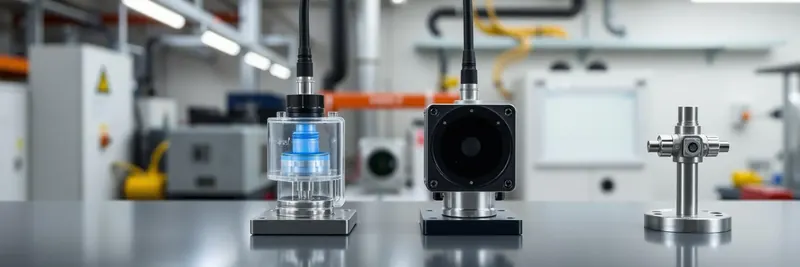
Sensing Technology Comparison
| Parameter | Float Switch | Capacitive | Optical (IR) | Ultrasonic |
|---|---|---|---|---|
| Moving Parts | Yes | None | None | None |
| Detection Type | Point (threshold) | Point or continuous | Point | Continuous |
| Accuracy | ±5 mm | ±2 mm | ±1 mm | ±1 mm |
| Vibration Tolerance | 5 g rms | 20 g rms | 15 g rms | 10 g rms |
| Fouling Resistance | Fair | Excellent | Poor | Good |
| Temp. Range | −30 to +110 °C | −40 to +125 °C | −40 to +105 °C | −20 to +85 °C |
| Typical Output | Reed contact | NPN/PNP / analog | Digital TTL | 4–20 mA / UART |
| Cost (OEM volume) | $ (lowest) | $$ (moderate) | $$ (moderate) | $$$ (highest) |
Engineering Note — Technology Selection Rule of Thumb
Choose float switches for cost-driven, low-vibration applications (passenger car overflow reservoirs). Choose capacitive for harsh-vibration, long-life applications (commercial vehicles, off-highway). Choose optical where coolant chemistry is stable and fouling is minimal. Choose ultrasonic when continuous level measurement with mm-resolution is required (EV thermal management loops).
Key Design & Selection Criteria
Engine bay ambient can exceed 120 °C near exhaust manifold. Sensor electronics must survive continuous exposure — specify per ISO 16750-4 Grad 4 (engine bay, close to engine).
OAT, HOAT, and IAT coolants have different additive packages affecting ε_r (capacitive) and refractive index (optical). Validate with actual OEM-specified coolant at 30–60% glycol concentration.
Commercial vehicles: 20 g rms per ISO 16750-3. Off-highway: up to 50 g peak shock. Float sensors fail at >8 g — capacitive is the minimum viable technology above this threshold.
12 V systems: NPN/PNP open-collector with pull-up. 24 V heavy-duty: CAN J1939 PGN or configurable analog 0.5–4.5 V. All outputs must pass ISO 11452 bulk current injection.
Application-to-Technology Matrix
| Application | Recommended Technology | Key Requirement |
|---|---|---|
| Passenger car overflow reservoir | Float switch | Low cost, binary alert |
| Commercial truck (M&HCV) | Capacitive | 20 g vibration, 15-yr life |
| Construction / mining | Capacitive (IP69K) | 50 g shock, dust/water ingress |
| Generator set (DG) | Capacitive + switch pair | Redundancy: alarm + shutdown |
| EV thermal management loop | Ultrasonic (continuous) | mm-level resolution, dielectric fluid |
| Industrial chiller | Capacitive / optical | Clean coolant, BMS integration |
Validation & Qualification Framework
Complete environmental testing suite for road vehicles
EMC immunity — radiated, conducted, BCI
IP67/IP69K ingress protection testing
Passive component automotive qualification
Quality management for series automotive production
Corrosion testing in engine coolant environments
Emerging Trends in Coolant Level Sensing
Need Help Selecting a Coolant Level Sensor?
Our engineering team can recommend the optimal sensing technology for your thermal environment, vibration class, and coolant chemistry. Contact us to start.
People Also Read
Capacitive Coolant Sensors for Automotive
How capacitive coolant level sensors work and OEM sourcing considerations.
12 min read
Read MoreEngine Oil & MAP Pressure Sensors Guide
Engine pressure monitoring fundamentals and sensor selection for OEMs.
11 min read
Read MoreOil Pressure Sensor Guide
Comprehensive oil pressure sensor reference — symptoms, diagnostics, maintenance.
15 min read
Read More