
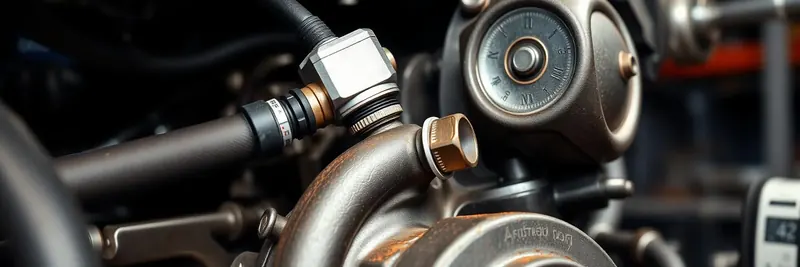
What is an EGR Pressure Sensor?
An EGR (Exhaust Gas Recirculation) pressure sensor monitors exhaust-gas pressure in the EGR passage between the exhaust manifold and the intake manifold. It feeds the ECU a real-time signal so the EGR valve can be modulated to recirculate the exact mass of inert gas needed to suppress combustion temperatures and NOx formation. In modern diesel and select gasoline engines, ceramic piezoresistive sensors with ratiometric 0.5–4.5 V output, ±3% accuracy and 200 °C media tolerance are standard.
How Does an EGR Pressure Sensor Work?
An EGR pressure sensor uses a piezoresistive ceramic or stainless-steel diaphragm exposed to exhaust gas. Pressure deflects the diaphragm; a Wheatstone bridge converts the strain into a millivolt signal that an on-chip ASIC amplifies and temperature-compensates to a 0.5–4.5 V analog or SAE J2716 SENT digital output. Many systems use a delta-P (differential) sensor that measures pressure drop across an orifice plate; combined with exhaust temperature, the ECU calculates the recirculated mass-flow rate.
What Are the Symptoms of a Bad EGR Pressure Sensor?
- P0470–P0473 exhaust pressure sensor circuit DTCs
- P0401 / P0402 EGR flow insufficient or excessive
- Check Engine Light, derated power (limp mode) and rough idle
- Increased NOx readings at the tailpipe and failed PUC / emissions test
- Black smoke under load (over-fuelling because EGR mass is mis-estimated)
EGR Pressure Sensor Specifications
| Parameter | Typical Value |
|---|---|
| Pressure range | 0–250 kPa absolute (gauge variants 0–500 kPa) |
| Output | 0.5–4.5 V ratiometric or SAE J2716 SENT |
| Accuracy | ±3% FS (−40 °C to +135 °C) |
| Media temperature | −40 °C to +200 °C continuous |
| Diaphragm | Alumina (Al2O3) ceramic / 316L SS |
| Protection | IP67 / IP69K, AEC-Q100 |
Why Ceramic Diaphragms for EGR?
EGR gas contains soot, sulphur compounds, NOx and unburned hydrocarbons that attack metal diaphragms over time. Alumina ceramic is chemically inert, withstands continuous 200 °C exposure without drift, and resists deposit build-up that would otherwise mask diaphragm deflection. Sensing Technologies' ceramic EGR pressure sensors are validated to ISO 16750 and AEC-Q100 for India's BS-VI diesel platforms. Read more on ceramic sensor technology →
EGR Pressure Sensor Manufacturer in India
Sensing Technologies Pvt. Ltd. is an IATF 16949:2016 certified manufacturer of EGR pressure sensors based in Mumbai, India, supplying Tier-1 OEMs since 1985. We provide PPAP Level 3 documentation, application-specific calibration and customisable connector and thread options (M10×1, M12×1.5, ⅛-27 NPT). Request a sample or RFQ →
Need an EGR Pressure Sensor for Your Engine Platform?
Our engineering team can specify the correct pressure range, output protocol and seal material for your BS-VI, Euro 6 or off-highway diesel programme.