
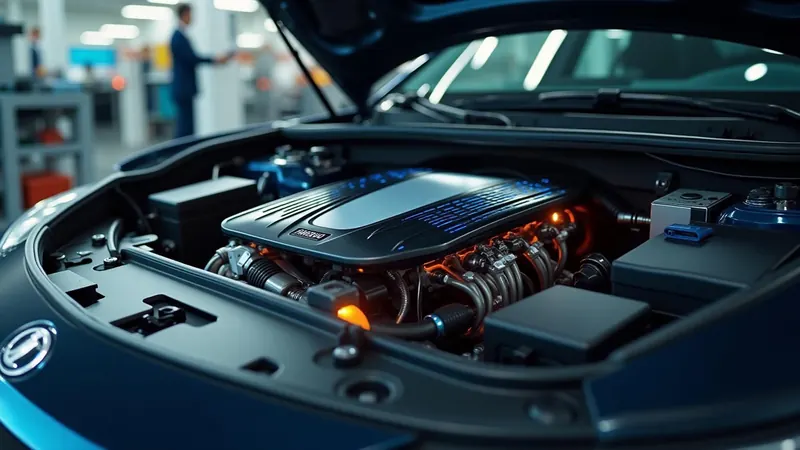
What Are Automotive Sensors?
Automotive sensors are electronic devices that convert a physical quantity — pressure, temperature, position, speed, light, gas concentration or chemical composition — into an electrical signal the vehicle's electronic control units (ECUs) can read. A modern passenger car contains between 60 and 100 sensors, and a premium EV or commercial vehicle can carry 200 or more. They are the eyes and ears of the engine-management, transmission, brake, HVAC, safety and battery-management systems, and every closed-loop control law in the vehicle depends on them.
How Many Sensors Are in a Car?
A modern internal-combustion passenger car typically uses 60–100 sensors. A premium SUV with advanced driver-assistance systems (ADAS), adaptive damping and a high-feature HVAC system can carry 150+ sensors. Battery electric vehicles add another 30–80 sensors for cell-level voltage, temperature, current, isolation and pack pressure monitoring, plus on-board charger and DC-DC converter sensing. Commercial vehicles and off-highway machines add wheel-speed, hydraulic, pneumatic and exhaust after-treatment sensors on top of the ICE baseline.
Types of Car Sensors by Function
The cleanest way to think about automotive sensors is by what they measure. Six families cover almost every sensor on a vehicle:
1. Pressure Sensors
Measure absolute, gauge or differential pressure of liquids and gases. Used for engine oil pressure, manifold absolute pressure (MAP), fuel-rail pressure, EGR differential pressure, transmission line pressure, HVAC refrigerant pressure and EV battery-pack pressure. Modern automotive pressure sensors are ceramic thick-film or silicon piezoresistive, with 0.5–4.5 V ratiometric or SENT digital output. See our pressure sensors range and our deep-dive on pressure sensor types.
2. Temperature Sensors
Continuous NTC thermistors for coolant temperature (ECT), intake-air (IAT), exhaust-gas (EGT), oil, transmission, HVAC evaporator and EV battery cell temperature. Snap-action temperature switches trigger radiator fans, glow plugs and over-temp warnings. Explore our temperature sensor range.
3. Position & Speed Sensors
Hall-effect and variable-reluctance sensors for crankshaft and camshaft position, wheel speed (ABS), gearbox shaft speed, throttle position (TPS), accelerator-pedal position (APP), steering angle and seat position. See our position sensors range.
4. Level & Flow Sensors
Capacitive non-contact coolant level sensors, fuel-tank level senders, washer-fluid level switches, oil-level sensors, urea (AdBlue) level and water-in-fuel sensors for diesel filters. Air-mass-flow (MAF) and exhaust-flow sensors fall here too.
5. Gas, Oxygen & Emissions Sensors
Lambda (O₂) sensors, NOx sensors, particulate-matter sensors and exhaust-pressure sensors for diesel particulate filter (DPF) regeneration. These keep tail-pipe emissions inside BS6 / Euro 6 / Bharat Stage limits.
6. Switches & Proximity Sensors
On/off devices including oil pressure switches, brake-light switches, door-ajar / sliding-door contact switches for vans and central locking, hood-latch switches and seat-belt buckle switches.
Sensors by Vehicle Sub-System
| Sub-system | Typical Sensors | Purpose |
|---|---|---|
| Engine / Powertrain | MAP, MAF, IAT, ECT, oil pressure, fuel-rail pressure, crank, cam, knock, O₂, EGR | Fuel & ignition control, emissions, diagnostics |
| Transmission | Line pressure, oil temperature, input/output speed, range / shift position | Shift quality, line-pressure control, DTCs |
| Brakes / Chassis | Wheel speed, steering angle, yaw, lateral-g | ABS, ESC, EHB, EBD, traction control |
| HVAC / Cabin | Refrigerant pressure, evaporator temperature, sun-load, humidity, AQI | Cabin comfort & defrost logic |
| Body & Safety | Airbag-crash, seat-belt, door, hood, occupant-detection | Passive safety & convenience |
| EV / Hybrid | Cell voltage, cell temperature, current shunt, isolation, battery-pack pressure, OBC inputs | BMS, thermal management, charging |
| ADAS | Camera, radar, ultrasonic, LiDAR | Lane-keep, AEB, ACC, parking |
Signs of a Bad Car Sensor
A failing sensor usually shows up as a check-engine light (MIL) and a diagnostic trouble code (DTC). Common symptoms across sensor families:
- Engine sensors — rough idle, hesitation, poor fuel economy, hard start (MAP, MAF, O₂, ECT)
- ABS / wheel-speed sensors — ABS warning light, traction-control disabled
- Pressure sensors — DTCs in the P010x–P02xx range, limp-home mode
- Temperature sensors — fan running constantly or never, poor cabin cooling
- Position sensors — gear-selection faults, stalling, no-start (crank / cam)
For deeper symptom-and-fix detail by sensor type see our oil pressure sensor guide, MAP sensor guide, EGR pressure sensor guide and coolant level sensor guide.
How Modern Car Sensors Connect to the Vehicle Network
Legacy sensors output an analog voltage (typically 0.5–4.5 V ratiometric) or a switched ground. Modern automotive sensors increasingly use digital protocols: SENT (SAE J2716) for high-resolution single-edge nibble transmission, LIN bus for low-speed body sensors (HVAC blower, rain, seat), and CAN or CAN-FD for high-speed safety-critical sensing such as battery management and ADAS. EV battery-pack and OBC sensors increasingly integrate isolated CAN-FD with built-in functional-safety (ISO 26262 ASIL-B/C) diagnostics.
Sensors for Electric Vehicles
EVs delete the ICE-specific sensors (MAP, MAF, crank, O₂, EGR) but add a dense layer of new ones: cell-level voltage and temperature sensors inside the BMS, hall-effect current sensors on the high-voltage bus, isolation-monitoring sensors, battery-pack pressure sensors for thermal-runaway venting, motor-position resolvers and high-voltage interlock loop switches. See our EV battery sensors guide and our EV oil-pressure sensors guide. Power electronics for these systems is covered by our DC-DC converters and on-board chargers.
Choosing the Right Sensor: Selection Checklist
- Measurement range & accuracy matched to the worst-case operating condition, not the nominal one
- Operating temperature — under-hood typically −40 to +135 °C, EV battery −40 to +85 °C, exhaust up to +850 °C
- Ingress protection — IP67 or IP6K9K for chassis-mount, IP54 for in-cabin
- EMC / ESD compliance — ISO 7637, ISO 11452, CISPR 25
- Electrical interface — analog ratiometric, SENT, LIN or CAN
- Connector & thread / mounting — confirm OEM standard (Sumitomo, JST, Deutsch, AMP, M12, etc.)
- Functional-safety rating (ISO 26262 ASIL) for brake, steering and battery sensors
- Supplier quality system — IATF 16949:2016 with PPAP / APQP capability
Automotive Sensor Manufacturer in India
Sensing Technologies designs and manufactures automotive sensors under IATF 16949:2016 from our Mumbai facility. Our portfolio spans pressure, temperature, position, level and proximity sensors for OEM passenger-car, two- and three-wheeler, commercial-vehicle, off-highway and EV programmes — from prototype through PPAP to volume production with connector, thread and output-protocol customisation. Talk to our engineers about your sensor programme →
Need a Custom Automotive Sensor?
From standard catalogue parts to fully bespoke OEM designs — IATF 16949 certified, made in India.